

📱 Amazon Fire Phone — A Cautionary Tale of Ignoring Market Research

In July 2014, Amazon launched its first-ever smartphone, the Fire Phone — a move that initially caught the tech world’s attention but ultimately became one of the company’s most notable business missteps.
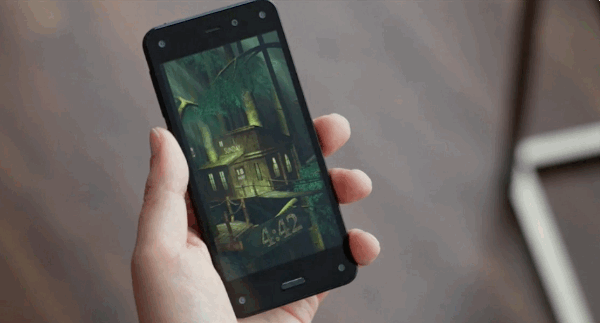
The Fire Phone promised users a fresh experience: a 3D display, instant access to Amazon’s ecosystem, and innovative features like Firefly technology. However, despite its novelty, the device failed to align with users’ everyday needs and quickly struggled in the market — for a variety of reasons.
📱 Innovative, Yet Cumbersome to Use
3D Display: While the dynamic 3D effects were intriguing, they were visually straining for many users and caused fatigue during prolonged use.
Firefly Technology: Perhaps the most fascinating feature, Firefly could identify products, songs, and text. However, it didn’t directly address most users’ daily needs. For instance, shoppers rarely felt the necessity to scan products with Firefly in-store, making the feature’s real-life application limited.
Restricted to Amazon’s Ecosystem: The Fire Phone was deeply integrated with Amazon’s services, but this came at the expense of compatibility with other popular apps and platforms. As a result, it felt inconvenient for users who relied on a more diverse tech ecosystem in their everyday lives.
In short, these features were “innovative and interesting,” but they failed to deliver on the core requirements of being simple, practical, and seamlessly useful in daily life.
❌ Reasons for Failure
Launching Without Proper Market Research
The biggest flaw of the Amazon Fire Phone was misreading the market’s needs. Amazon’s primary goal was to draw customers into its own ecosystem, but most users were already accustomed to iPhones or Android devices and were reluctant to switch to a new platform. Research showed that consumers generally preferred devices that were practical, easy to use, and aligned with their daily needs.
Strong Competitors
In 2014, Apple’s iPhone and Samsung’s Galaxy series already held dominant positions in the market. While the Fire Phone introduced novel features, it lacked the competitive advantages needed to stand against such established brands. In terms of pricing, the Fire Phone was relatively expensive.
💡 Key Differences:
Although it was priced similarly to iPhone and Galaxy models, the Fire Phone lacked their strong brand recognition, widespread adoption, and access to massive app ecosystems like the App Store and Google Play.
In other words, consumers were left wondering, “Why pay the same price for an experimental product?”
Additionally, the Fire Phone was locked exclusively to AT&T’s network, further limiting its market reach. Essentially, it was like saying in Mongolia: “This phone can only be used with a Unitel SIM card.” If someone used another operator (like G-Mobile or Mobicom) and was interested in the Fire Phone, they simply couldn’t use it due to network incompatibility.

Operational Missteps and User Experience Issues
Although the Fire Phone offered innovative features such as the 3D display and Firefly technology, these didn’t align with users’ daily needs. While consumers appreciated the novelty, the high price tag and Amazon-exclusive ecosystem ultimately hurt sales. Moreover, the device suffered from short battery life and a limited selection of applications.
📉 Consequences
The Fire Phone was a commercial failure, causing Amazon to incur a loss of $170 million.
An unsold inventory worth $83 million remained on the market.
This failure served as a reminder to Amazon of the importance of understanding technology, the market, and customer needs simultaneously when developing a strategy.
💡 Business Lessons
No market research, no success: Understanding customer behavior, needs, and purchasing interests is the foundation of success. If a device is compatible only with its own platform, customer adoption will be limited.
Assess competitors and compare your product: In a market with strong competitors, a new product must offer clear advantages to stand out.
Value creation is key: Offering innovative technology alone is not enough. Customers prioritize products that are practical, usable in their daily lives, and deliver real value.


Comments